
The 8-Second Problem
What a Feature PM sees before anyone else, and why it matters more than the roadmap


There’s a specific kind of frustration that doesn’t have a name yet.
You open an app. You know what you want, vaguely. Something. The right something. And for about eight seconds, you just stare. Then you close it and open something else.
This happens more than product teams want to admit. Most of them miss it entirely, because their dashboards don’t measure it.
Feature PMs see it.
The moment nobody was tracking
Around 2014, Spotify had a real problem.
Forty million songs. The catalog was enormous. The engineering was solid. The licensing deals had been brutal, but they had worked.
And users were drowning.
Charlie Hellman, then a Feature PM on the discovery team (and later VP of Product), started noticing something in the behavioral data. Users would open the app, hover near the search bar for a few seconds, and then leave.

The app hadn’t broken. The music was there. But the act of choosing had become its own obstacle.
The insight that followed seems obvious now. Most of them do.
Users didn’t actually want to pick a song. They wanted to feel something. They wanted the right music for right now, without the cognitive overhead of deciding what that meant.
Spotify had been thinking like a library. Charlie’s team started thinking like a DJ who knew you personally.
That reframe became Discover Weekly. A playlist that reset every Monday. Personal, curated, requiring zero decision-making from the user. It launched in 2015. Within ten weeks, 1.5 billion tracks had been streamed from it.
What the job actually looks like
A Feature PM’s world is deliberately small.
Charlie’s team wasn’t responsible for all of Spotify. They were responsible for a single slice of the user experience: the gap between “I want music” and “music is playing.” Everything else was someone else’s problem.
That sounds limiting. It’s the opposite.
Owning a small slice of someone’s life means you can go deep in ways that broader PMs can’t. You notice the eight-second pause. You care about the exact wording of the empty state. You run experiments on whether showing three playlist options instead of five reduces abandonment.
The work is obsessive by design.
Instagram’s Explore team operates the same way. Their slice is the moment after a user finishes their home feed and still wants more. That sounds simple. The execution involves understanding boredom, curiosity, and the exact threshold at which “browsing” tips into “I’ve been here too long.” Every decision inside that tab lives on the border between engaging and addictive. Feature PMs there aren’t just thinking about click-through rate. They’re thinking about what users feel when they finally put the phone down.
The metrics that keep Feature PMs honest
Every Feature PM tracks adoption. Did people actually use the thing?
But adoption is a trap on its own. It’s the metric that makes stakeholders happy and hides the real story.
The questions that matter more: Did users come back? Did the feature do what the user actually came to do? And the hardest one: did this improve the core metric, or did it just get used?
Discover Weekly had staggering adoption numbers. But Charlie’s team tracked whether it increased total listening time and reduced subscriber churn. It did both. That’s the difference between a feature that impresses and a feature that compounds.
Google Maps has a Feature PM who, at some point in history, obsessed over the rerouting moment. That four-second window when the app says “rerouting” and you’re deciding whether to trust it. The trust signal there isn’t just visual design. It’s the voice tone, the speed of the response, and whether the new route is better enough that the user doesn’t override it manually. Someone cared deeply about that specific moment. The retention numbers for navigation probably showed why.
Amazon’s one-click purchase started as a Feature PM decision too. The insight wasn’t about convenience for its own sake. It was about friction as a revenue leak. Every additional step between “I want this” and “I bought this” was a moment where a user could reconsider, get distracted, or simply stop. Removing one step didn’t just improve conversion. It changed how users related to buying entirely.
The “impressive but inert” trap
The enemy of a good Feature PM isn’t a bad product decision. The enemy is the feature that earns applause at launch and disappears from usage data three weeks later.
These features are everywhere. They’re announced in press releases. They get their own landing pages. They look extraordinary in demos.
Users click them once, find them clever, and never return.
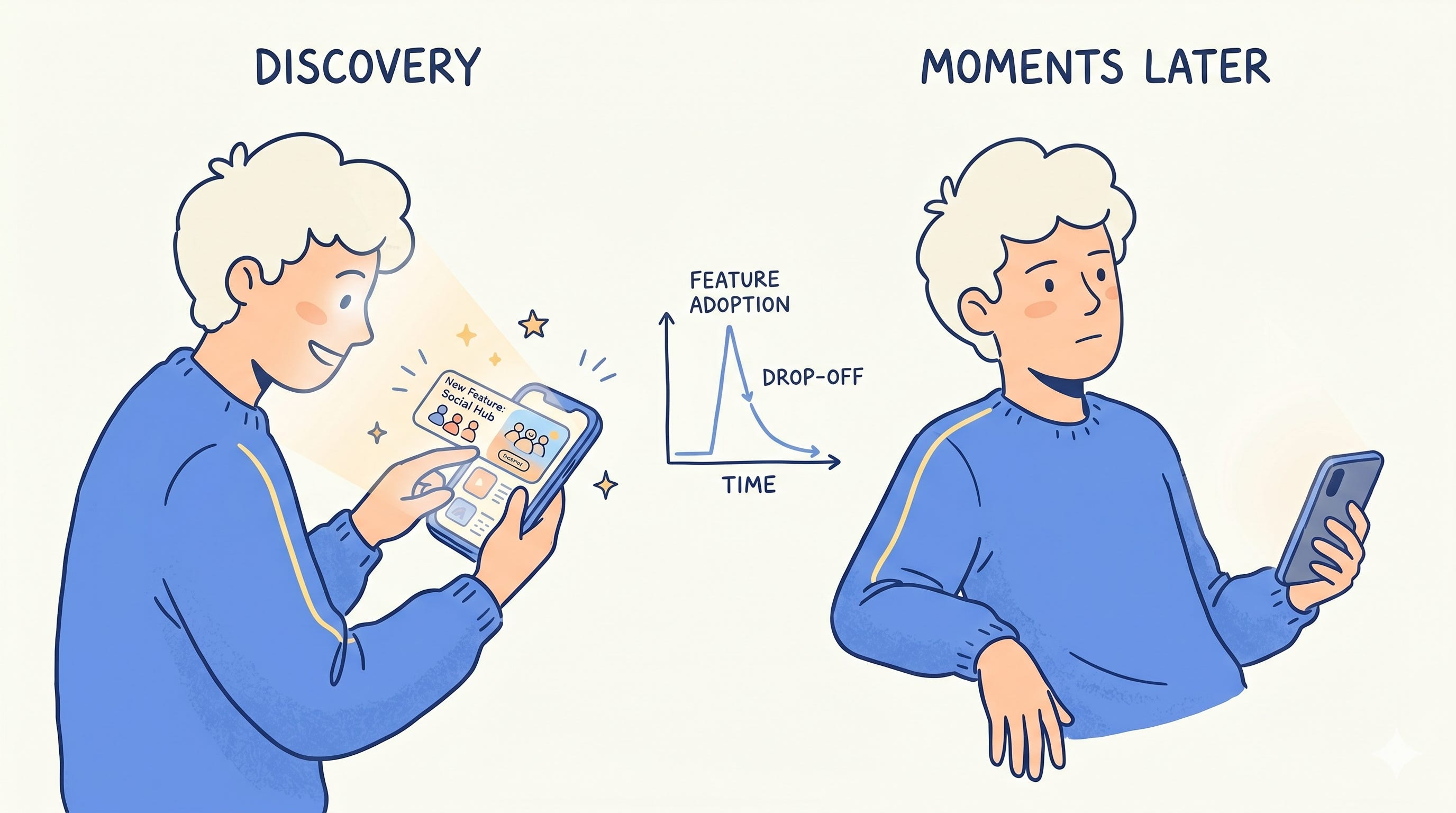
I’ve been that user. You probably have too.
The Feature PM who can tell the difference between a feature that will compound versus one that will plateau has a very specific skill. They’re reading the emotional state of the user, not just the task.
Notion’s onboarding team learned this through a painful iteration cycle. An empty canvas is both the most powerful and the most paralyzing thing you can show a new user. Early versions of Notion left users staring at blankness, unsure where to begin. The retention numbers were brutal. The fix wasn’t adding more features. It was reducing optionality at the exact moment when optionality felt like burden. Templates, guided starts, starter content: all of it designed to answer one question: what do I do right now?
That question is always the Feature PM’s actual job.
What the eight seconds really mean
The pause before a user decides whether to stay or leave isn’t really about the product. It’s about cognitive load, emotional state, and whether the product understands what moment the user is actually in.
Feature PMs treat that gap as a design surface. A place where a small decision changes what happens next entirely.
Most product conversations happen at the level of the roadmap. Features, timelines, capacity, quarterly goals. Feature PMs operate one layer below that, where the user is real and the moment is specific and the eight seconds are ticking.
The Discover Weekly story isn’t really about music recommendation. It’s about a team that cared enough about one moment in the user experience to rebuild how they thought about the entire product.
That’s the job. Own the moment. Make the right decision disappear.
The eight seconds either feel like possibility, or they feel like work. And the products that feel effortless? Someone spent months obsessing over that distance. You just didn’t notice, which means they got it right.
If this reframed how you think about product work, follow along. More on the invisible mechanics behind products that feel effortless.
I personally think starting with an empty canvas is hard.